I used to think I was good at paying attention in doctor's appointments.
I'd walk in prepared, ask my questions, listen carefully, nod along. And when I left, I genuinely believed I understood everything.
Then I'd get home.
And somewhere between the parking lot and my kitchen, things started to unravel.
Was I supposed to take that medication once a day or twice? Did they say to come back in two weeks or a month? What was the name of that test I was supposed to schedule?
It's a strange feeling realizing that something important just… didn't stick.
And it happens a lot more than we like to admit.
Forgetting isn't a memory problem. It's a design problem.
There's this assumption baked into healthcare that if a doctor explains something clearly, the patient will remember it. That understanding happens in real time, and memory just follows.
But that's not how people work.
Doctor visits are fast. They're often stressful. You're hearing new information, sometimes worrying information, and trying to process it all while also thinking about what to ask next. Your brain is juggling a lot.
So it's not surprising that studies have found that patients forget somewhere between 40% to 80% of what they're told during a visit, and even more concerning, a lot of what people do remember isn't quite right. That's not a small gap. That's the majority of the conversation.
I've started to think of it less as a memory problem and more as a design problem.
We're asking people to absorb complex, high-stakes information in a short window of time, often without any reliable way to revisit it later. If you see multiple doctors, or manage medications, or are helping a parent navigate their care, it becomes even harder. There's no single place where everything lives. No clear thread tying it all together.
You're left relying on memory to hold a system that's inherently fragmented.
That's where things break.
What people who handle this well actually do
Over time, I've noticed that people who manage this better don't necessarily have better memories. They just approach appointments differently.
They prepare a little before they walk in. Not in a formal way, just enough to know what they want to get out of the visit. A few questions, a quick list of what's been going on.
Sometimes they bring someone with them. Not always, but when things feel more serious or complicated, having another person in the room changes everything. And sometimes they ask to call a friend or family member to be on the call while they are at the doctor's office so that they can have another pair of ears to listen. This helps people remember different details and remember more details.
In addition, I have found when a third party is in the room the doctor is more willing to slow the conversation down. To ask, "Can you explain that again?" or "What's the most important thing I should focus on here?" That small pause makes a bigger difference than you'd expect.
And before they leave, they'll often do something simple but surprisingly powerful. They'll repeat back what they heard. It feels a little awkward the first time you do it, but it forces clarity. Either you've got it right, or you catch the gap immediately.
Why taking notes isn't enough
For a long time, I thought telling my patients to take notes was the answer.
And it helps, to a point.
But there's a tradeoff. When you're writing, you're not fully listening. You're deciding what matters in real time, which isn't always easy when you don't yet understand the full picture. You end up with fragments instead of a complete story.
The more I've thought about it, the more it feels like we're solving the wrong problem.
The goal shouldn't be to remember everything your doctor says.
The goal should be to not have to rely on memory at all.
That's why more people are starting to record their visits, with permission.
Not because they're trying to document every word, but because it gives them something they've never really had before: the ability to go back. To listen again. To catch what they missed. To share it with a spouse or a parent or a sibling who wasn't there.
It changes the dynamic completely. The pressure to "get it right" in the moment goes away.
What's becoming clear is that healthcare is only getting more complex. More specialists. More medications. More decisions that need to be made outside the exam room. And yet, the expectation hasn't really changed. We still assume that one conversation is enough. It's not.
Whether that's through notes, summaries, or recordings, the people who feel most confident about their care are the ones who have a way to revisit what was said after the fact.
Because that's when real understanding actually happens. Not in the room, but later, when you have space to process it.
Why I started working on LumiMD
And if you've ever left an appointment feeling like you missed something, or weren't quite sure what to do next, you're not alone.
You're just experiencing a system that was never really designed for how people actually think and remember.
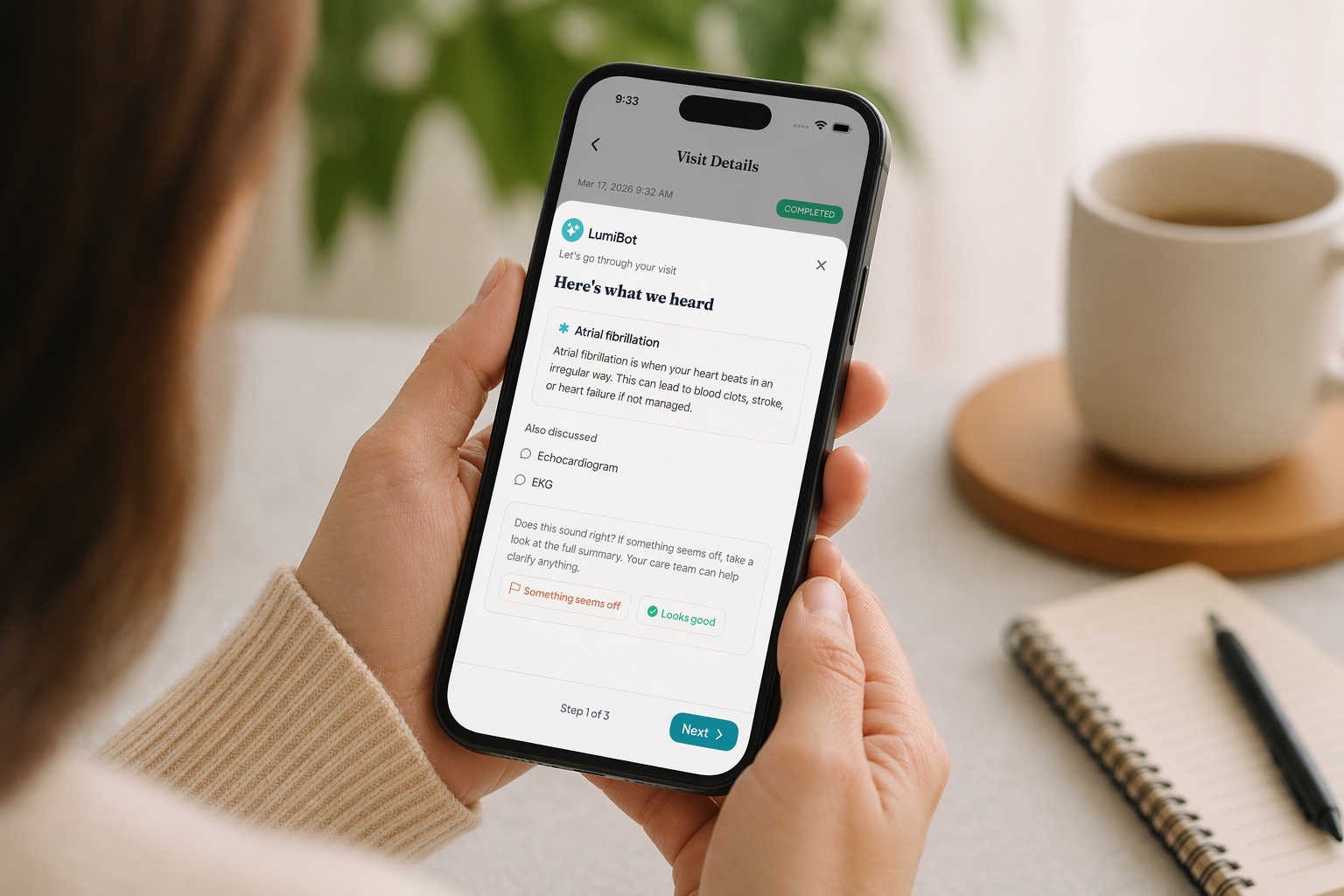
That realization is what ultimately led me to start working on LumiMD. Not because I thought people needed another health app, but because I kept coming back to the same problem over and over again. People weren't struggling because they weren't trying hard enough to remember. They were struggling because there was no real system designed for them to actually capture and use the information after they left the room. Everything important was happening in a single conversation, and then it was gone.
What felt missing wasn't more effort from patients. It was a simple way to hold onto what actually mattered. To be able to go back, revisit what was said, understand it more clearly, and share it with someone else if needed. Something that didn't rely on memory or scattered notes, but instead gave people a clearer picture of their own care over time.
That's really where this idea came from. Not from technology first, but from that gap. The moment when you leave a visit and realize you're not entirely sure what just happened, even though you were paying attention the whole time.